
Blogs
Muscle Building Food

By Alizo Foods Meerut, UP 9 min read
Best Meats for Muscle Gain: A Complete Fitness Guide
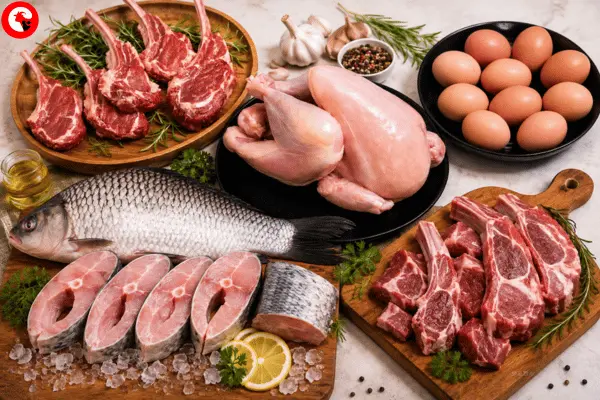
Chicken breast, mutton, fish, and eggs are all genuinely good for building muscle — but they're not interchangeable. Each one does a slightly different job, and knowing which does what makes meal planning a lot easier.
If you've ever stood in front of the fridge trying to decide what to cook for your next high-protein meal, this guide settles it. We'll walk through actual protein content, how well your body absorbs each one (this matters more than most people realize), and how to build all four into a realistic weekly meal plan — not just a theoretical one.
Why Protein Quality Matters, Not Just Protein Quantity
Two foods can both say "20 grams of protein" and still be worlds apart in how much of that protein your body actually uses to build muscle. That difference comes down to two things: whether the protein is complete (contains all 9 essential amino acids your body can't make on its own), and how bioavailable it is.
What Is Protein Bioavailability?
Bioavailability is simply how efficiently your body can digest, absorb, and actually use a protein once you've eaten it. It's commonly measured using Biological Value (BV) — a scale where egg protein is used as the reference point, scoring 100. Everything else is measured against it.
The good news: chicken, mutton, fish, and eggs are all complete proteins with strong bioavailability. None of them are a bad choice. The differences that follow are about optimizing, not avoiding.
The Complete Comparison: Protein, Fat, Calories & Bioavailability
Here's how all four stack up, per 100 grams of raw weight — kept consistent across the board since that's how meat and fish are actually sold and weighed.
| Food | Protein | Fat | Calories | Bioavailability (BV) |
|---|---|---|---|---|
| Eggs (whole) | ~13g | ~10g | ~143 kcal | ~100 (reference) |
| Chicken Breast | ~23g | ~2.6g | ~120 kcal | ~79–84 |
| Fish (Basa) | ~15g | ~3g | ~90 kcal | ~76–83 |
| Mutton (Goat Meat) | ~20g | ~2.6g | ~122 kcal | ~74–80 |
A quick note on mutton: this refers specifically to goat meat, not lamb. Goat is naturally lean — comparable to chicken breast in fat content — which is very different from the fattier profile most people associate with "mutton."
Ranking the Best Protein Sources for Muscle Gain
All four are legitimate choices. Here's how they rank, and — more usefully — what each one is genuinely best at.
Eggs — The Bioavailability Champion
Best absorptionEggs set the benchmark that every other protein source is measured against. Your body absorbs and uses egg protein more completely than almost any other whole food — which is exactly why BV scales use it as the reference point of 100. They're also the most versatile: cheap, quick to cook, and easy to add to any meal.
Chicken Breast — Best Protein-to-Calorie Ratio
Best for lean bulkingChicken breast delivers the highest protein density of the four — around 23g per 100g raw, with barely any fat. For anyone trying to build muscle without piling on unnecessary calories, this ratio is hard to beat. It's the default choice in most fitness meal plans for good reason.
Fish (Basa) — Easiest to Digest
Best for recovery daysFish is generally lighter on digestion than both poultry and red meat, which makes it a smart choice on rest days or after a heavy training session when your body has less to spare for digestion. Basa specifically is low-calorie and boneless, making it an easy, low-effort protein to add without much prep.
Mutton (Goat Meat) — Best for Iron, Zinc & B12
Best for bulking phasesGoat meat brings something the other three don't offer as strongly: significantly higher iron, zinc, and B12 — all of which matter for energy, recovery, and training capacity. It's slightly more calorie-dense and takes a bit longer to digest, which actually works in your favor during a bulking phase when higher intake is the goal.
How to Build These Into a Fitness Meal Plan
You don't need to pick one — the smartest fitness meal plans rotate all four across the week. Here's a simple structure that works well:
- Breakfast: 2–3 whole eggs — fast, cheap, and the most bioavailable start to the day
- Post-workout / Lunch: Chicken breast — the best protein-per-calorie option when you're training hard and want to stay lean
- Rest day / Lighter meal: Fish — easier on digestion when your body is recovering rather than training
- Bulking phase / Weekend meal: Mutton — more calorie-dense, with a strong micronutrient profile to support harder training blocks
Rotating through all four also solves a problem most high-protein diets run into: food fatigue. Eating chicken breast every single day gets old fast — mixing in eggs, fish, and mutton keeps a high-protein diet sustainable long-term, which matters more for results than any single "best" food.
A Sample 3-Day Rotation Plan
Here's what that rotation actually looks like across a few days, so it's not just a theory:
| Day | Breakfast | Lunch | Dinner |
|---|---|---|---|
| Day 1 | 3 eggs + toast | Chicken breast + rice + salad | Basa fish curry + roti |
| Day 2 | 2 eggs + oats | Grilled chicken breast + vegetables | Mutton curry (moderate portion) + dal + roti |
| Day 3 | 3 eggs, any style | Grilled Basa + rice or quinoa | Chicken breast stir-fry + vegetables |
Notice mutton appears just once across the three days, in a moderate portion — that's intentional. Since it's more calorie-dense than the other three, it fits best as a periodic addition rather than a daily staple, especially outside a dedicated bulking phase.
How Much Protein Do You Actually Need?
For muscle gain, a commonly used range is roughly 1.6 to 2.2 grams of protein per kilogram of bodyweight per day. For a 70kg person, that works out to about 112–154g of protein daily — realistically split across 3–4 meals rather than one large serving.
Practical example: 3 eggs (breakfast) + 150g chicken breast (lunch) + 150g fish or mutton (dinner) gets a 70kg person close to 100g of protein from whole food alone — before counting rice, dal, or any other sources.
Sourcing Consistent Quality Protein
The biggest obstacle to a high-protein diet usually isn't knowing what to eat — it's actually getting fresh, good-quality meat consistently, without a market trip eating into your day every single time.
This is where Alizo Foods makes things easier for anyone training in Meerut. Fresh, boneless chicken breast and lean goat meat (₹450 for 500g, ₹875 for 1kg) — both sourced and delivered fresh — reach your door in as little as 90 minutes. No early morning market runs, no guessing whether today's cut is actually fresh. If fish fits into your rotation too, boneless Basa is available the same way.
Frequently Asked Questions
Which is the best protein source for muscle gain — chicken, mutton, fish, or eggs?
All four are strong choices. Eggs have the highest bioavailability, chicken breast has the best protein-to-calorie ratio, fish is the easiest to digest, and mutton (goat meat) offers the strongest iron, zinc, and B12 content. The best approach is rotating between all four rather than relying on just one.
How much protein is in chicken breast per 100g?
Raw, skinless chicken breast has approximately 23g of protein per 100g, with very low fat (around 2.6g) — one of the best protein-to-calorie ratios of any common protein source.
Is mutton good for building muscle?
Yes. Goat meat (what's commonly called mutton in India) has around 20g of protein per 100g, and is naturally lean — comparable to chicken breast in fat content. It's also higher in iron, zinc, and B12 than the other three options, which supports training and recovery.
What is protein bioavailability and why does it matter?
Bioavailability measures how efficiently your body can digest and use a protein source. It's measured on a Biological Value (BV) scale, with egg protein as the reference standard at 100. A higher BV means more of the protein you eat is actually usable by your body.
How much protein do I need per day to build muscle?
A commonly used range is 1.6 to 2.2 grams of protein per kilogram of bodyweight per day, spread across 3–4 meals rather than one large serving.
Can I get fresh chicken and mutton delivered in Meerut?
Yes. Alizo Foods delivers fresh, boneless chicken breast and lean goat meat (mutton) to homes in Meerut, typically within 90 minutes of ordering.
The Bottom Line
There's no single "best" protein here — chicken breast wins on calorie efficiency, eggs win on absorption, fish wins on digestibility, and mutton wins on micronutrients. The real advantage comes from rotating all four through your week, both for nutritional variety and to keep a high-protein diet something you can actually stick to long-term.
Fresh Protein, Delivered to Your Door in Meerut
Boneless chicken breast · Lean goat meat · Boneless Basa fish · Delivered in 90 minutes
Order on WhatsAppAlizo Foods
Alizo Foods delivers fresh, traceable chicken, mutton, and fish directly to homes in Meerut — with honest sourcing standards and no shortcuts.

About Mohd Furquan
Mohd Furquan is the founder of Alizo Foods, Meerut's fresh meat delivery service. With over 10 years of hands-on experience in the fresh poultry and meat trade, he personally oversees sourcing, cutting, and cold-chain delivery for every order that leaves the facility. Since 2019, Alizo Foods has served hundreds of families across Meerut with hygienically vacuum-sealed chicken, mutton, and fish — delivered fresh to their door. Mohd writes on food safety, meat hygiene standards, and practical healthy eating guidance for Indian households.
View all posts by Mohd Furquan